
MER2-630-60U3M
The MERCURY2 USB3.0 series (MER2-U3) camera is DAHENG IMAGING’s new generation area scan industrial digital camera, featuring outstanding performance, compact design and extremely low noise. The MER2-630-60U3M/C camera is a monochrome/color USB3 Vision camera with the Sony IMX178 CMOS sensor. Thanks to the compact design (29mm × 29mm × 29mm), robust metal housings and locking screw connectors, the MERCURY2 cameras can secure the reliability of cameras deployed in harsh environments. The MER2-630-60U3M/C camera has opto-isolated I/Os. The GPIOs give MER2-U3 cameras maximum flexibility to adapt to specific needs. The MERCURY2 family cameras are especially suitable for machine vision applications such as industrial inspection, medical, scientific research, education, security and so on.
Specifications
- Model
- MER2-630-60U3M
- Product Families
- MERCURY2
- Resolution
- 3088×2064
- Frame Rate (fps)
- 60
- Sensor Manufacturer
- Sony
- Sensor
- 1/1.8" IMX178 Rolling shutter CMOS
- Pixel Size
- 2.4μm
- Sensor size (computed)from resolution × pixel pitch
- 7.41 × 4.95 mm
- Sensor diagonal
- 8.91 mm
- Pixel Bit Depth
- 8 bit,10 bit
- Data Interface
- USB3.0
- Lens Mount
- C,CS
- Spectrum
- Mono
- Pixel Formats
- Mono8,Mono10
- Signal Noise Ratio
- 40.18 dB
- Exposure Time
- Standard: 8μs ~ 1s
- Gain
- 0dB ~ 24dB
- Binning
- 1×1, 1×2, 1×4, 2×1, 2×2, 2×4, 4×1, 4×2, 4×4
- Decimation
- FPGA: 1×1, 1×2, 1×4, 2×1, 2×2, 2×4, 4×1, 4×2, 4×4
- Reverse X/Y
- Reverse X/Y
- I/O Interface
- 1 input and 1 output with opto-isolated, 2 programmable GPIOs
- Power Requirement
- Power over USB3.0
- Power Consumption
- 1.82 W @ 5 VDC
- Operating Temp.
- 0°C ~ +45°C
- Storage Temp.
- -20°C ~ +70°C
- Operating Humidity
- 10% ~ 80%
- Dimensions (W×H×L)
- 29 mm × 29 mm × 29 mm (w/o connectors)
- Weight
- 65 g
- Conformity
- CE, RoHS, FCC, ICES, UKCA, UL, USB3.0 Vision, GenICam
Choosing a lens
Choosing a lens
The formula holds for standard (entocentric) lenses and assumes the working distance is much larger than the focal length. It does not apply to telecentric lenses, and it accounts for neither depth of field nor distortion.
Data cables that fit
Matched on connector and protocol from the manufacturer's catalogue — not its own recommendation list. Ask us to confirm
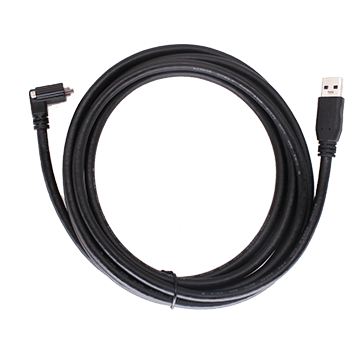
MV-ACU3-MBMs(down)-AM-ST-0.5m
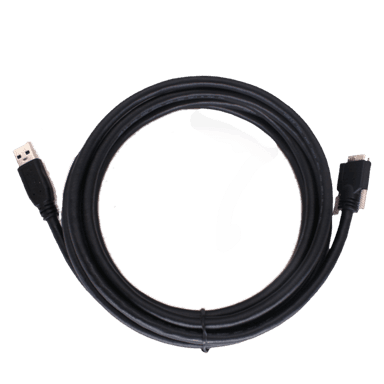
MV-ACU3-MBMs-AM-FL-3m
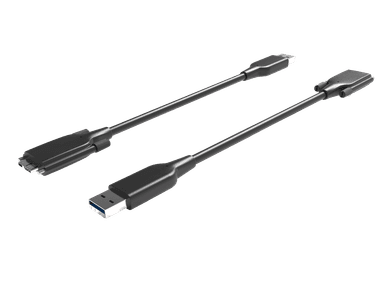
USB3.0 AOC fiber cable
MV-ACU3-MBMs-AM-ST-0.5m
MV-ACU3-MBMs(down)-AM-ST-1m
USB3.0 AOC fiber cable
MV-ACU3-MBMs-AM-ST-1m
MV-ACU3-MBMs(down)-AM-ST-2m
USB3.0 AOC fiber cable
MV-ACU3-MBMs-AM-ST-2m
MV-ACU3-MBMs(down)-AM-ST-3m